A review is often part of the first impression. Prospective customers may read what happened, how the business responded, and whether the public information seems current and credible.
Our approach to reputation growth
Online reputation management helps a business collect genuine customer feedback, monitor public reviews, respond thoughtfully, and route service concerns to the right person. It is for businesses whose customers use reviews when deciding whom to contact. Automate2Generate connects review workflows, brand voice, and team responsibilities without manufacturing praise or promising review removal.
A review is often part of the first impression. Prospective customers may read what happened, how the business responded, and whether the public information seems current and credible. Reputation work should support that evaluation with genuine feedback and useful responses, while also helping the team learn from recurring concerns.
We build a repeatable process around the business: when feedback is requested, which channels are used, who receives alerts, who can approve responses, and how issues reach someone able to resolve them. The objective is a system the team can maintain, rather than a campaign that produces a brief burst of requests and then stops.
What’s included in your project?
01Audit of review profiles, existing request practices, and team responsibilities.
02Approved honest-feedback request templates and reminder rules.
03Supported CRM or service-completion triggers with duplicate and stop handling.
04Brand-appropriate response principles and escalation guidance.
05Monitoring and alert ownership for agreed public profiles.
06Assistance documenting possible policy violations where appropriate.
07Reporting that separates review activity, service themes, and business outcomes.
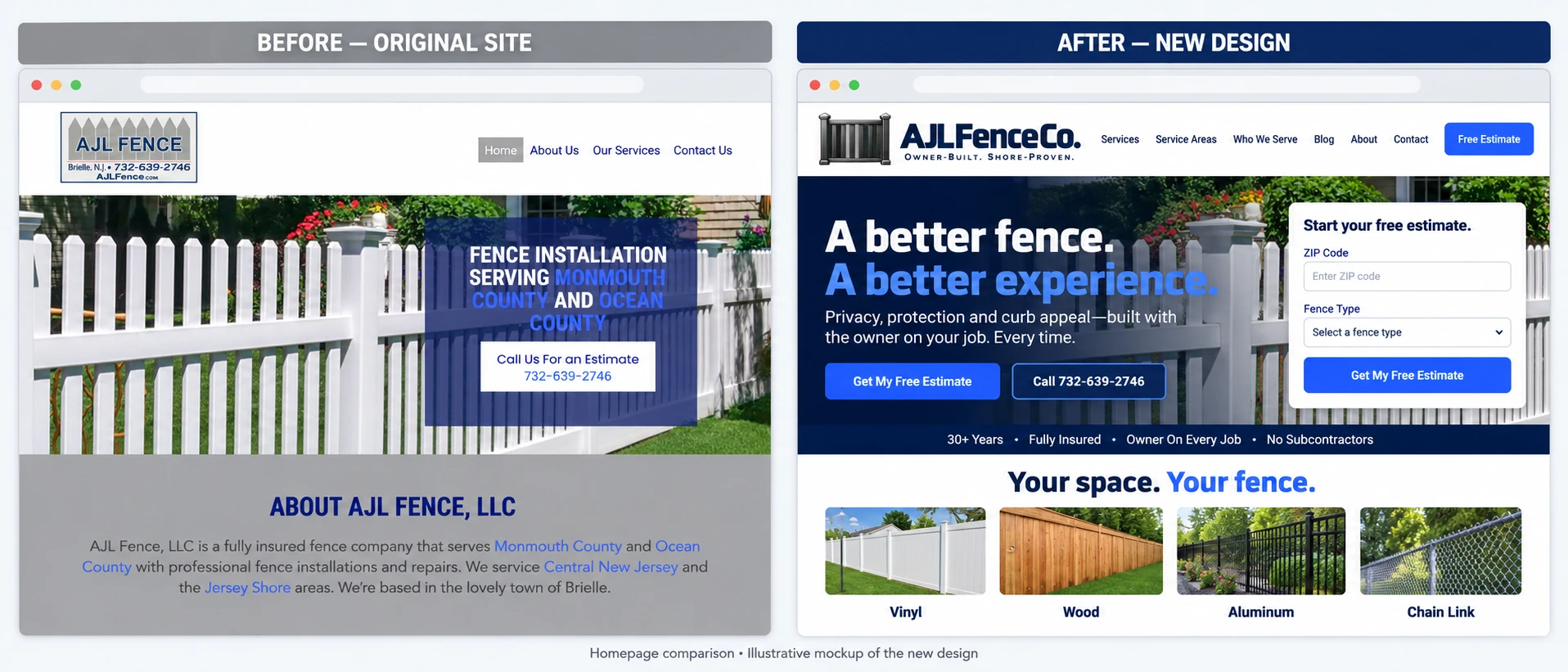
Design in practice
See what a clearer experience looks like.
Explore our portfolio for website design and implementation examples.
AJL Fence: original site and illustrative redesign.
The details that matter
A closer look at your project.
01
What does a reputation management service include?
The scope can include a review-process audit, profile inventory, request templates, workflow configuration, monitoring arrangements, response guidance, and practical reporting.
Explore this topic: What does a reputation management service include?
The scope can include a review-process audit, profile inventory, request templates, workflow configuration, monitoring arrangements, response guidance, and practical reporting. We review the customer journey to find an appropriate request point, such as a completed service or fulfilled order. The request should be understandable, relevant, and connected to a genuine customer experience.
Responsibilities matter as much as software. Someone should own review alerts, approve responses where necessary, investigate operational concerns, and keep business information current. If a platform or tool is part of the engagement, we identify access, subscriptions, notification settings, and maintenance needs. A dashboard is useful only when the team knows what to do with what it shows.
02
How should businesses ask customers for reviews?
The request should invite honest feedback in plain language.
Explore this topic: How should businesses ask customers for reviews?
The request should invite honest feedback in plain language. It can thank the customer, explain that a review helps others understand the experience, and provide the appropriate destination. It should not dictate a rating, supply words for the customer to copy, or make a benefit conditional on leaving praise. The business needs a consistent policy for deciding when requests are sent.
We do not build a workflow that sends satisfied customers to a public review page while diverting dissatisfied customers away from it. Private feedback can be useful, but it should not become a gate controlling who is allowed or encouraged to review publicly. Requests, reminders, and contact preferences should be configured thoughtfully so customers are not repeatedly chased after they respond or opt out.
03
How do thoughtful review responses protect trust?
A response is written for both the reviewer and future customers.
Explore this topic: How do thoughtful review responses protect trust?
A response is written for both the reviewer and future customers. It should acknowledge the substance of the feedback, reflect the business voice, and identify a reasonable next step when one is needed. Generic praise copied beneath every positive review can feel inattentive. Defensive paragraphs beneath criticism can expose more of the problem than they solve.
We develop response principles rather than a pile of rigid scripts. Positive feedback may deserve a short, specific acknowledgment. A complaint may require an internal review before posting, a concise public reply, and a private resolution channel. The response should avoid publishing customer details or making factual claims the business has not checked. Sensitive cases need an appropriate approval path.
04
Can negative or fake reviews be removed?
A review should not be described as removable simply because the owner disagrees with it.
Explore this topic: Can negative or fake reviews be removed?
A review should not be described as removable simply because the owner disagrees with it. Platforms make their own decisions under their policies. When a review appears to violate the applicable rules, the work can include documenting the concern, identifying the relevant policy, and assisting with a supported reporting or appeal process. That is different from a guaranteed deletion service.
For legitimate criticism, the useful work is often operational. The team may need to investigate what happened, correct a service issue, clarify expectations, or improve communication. We separate public-response writing from factual investigation and platform reporting. Manufacturing positive reviews to bury a complaint is not a credible resolution strategy and is not part of this service.
05
How can review requests connect to your existing systems?
A CRM, appointment system, or order workflow may provide an appropriate trigger for a request.
Explore this topic: How can review requests connect to your existing systems?
A CRM, appointment system, or order workflow may provide an appropriate trigger for a request. We check the actual completion event, customer record, contact preference, and selected review destination. The workflow should not send requests for canceled work, duplicate records, or transactions that have not reached the intended stage. If the data is unreliable, that needs attention before automation.
The review process also needs stop rules and monitoring. A customer who replies with an issue should reach a person rather than receive an unrelated reminder. Team alerts need an owner. Broken review links should be noticed and corrected. We test the path from completed service to request, response, and internal action where those elements are included in scope.
06
What should reputation reporting tell a business owner?
Useful reporting can describe review activity, response coverage, recurring feedback themes, unresolved issues, and whether the request workflow is operating as intended.
Explore this topic: What should reputation reporting tell a business owner?
Useful reporting can describe review activity, response coverage, recurring feedback themes, unresolved issues, and whether the request workflow is operating as intended. Counts and ratings should be reported accurately with the relevant platform and time period. An increase in reviews does not by itself prove an increase in qualified inquiries, and a rating should not become an excuse to ignore service quality.
This service fits businesses with genuine customers and someone responsible for following through on feedback. It is not a fit for purchasing reviews, selectively soliciting only positive ratings, or promising to erase legitimate criticism. Scope and pricing depend on the profiles, request channels, response volume, integrations, approvals, and ongoing monitoring responsibilities. Detailed case studies coming soon.
07
Where can you review our work?
Detailed case studies coming soon.
Explore this topic: Where can you review our work?
Detailed case studies coming soon. You can explore the Automate2Generate portfolio for published examples of our work. We distinguish completed work from measured results and publish client-specific outcomes only when the evidence is available and approved.
How does our process work?
Review the existing experience
We inventory public profiles, current requests, response habits, and service-completion data. The review identifies friction, unclear ownership, and opportunities for a consistent feedback process.
Write and define the workflow
We prepare honest request language, response guidance, timing, stop conditions, and approval routes. The process invites genuine feedback without selecting only customers expected to leave a positive rating.
Connect and test
We configure the agreed tools and test destinations, triggers, reminders, alerts, and customer replies. Operational issues are assigned to the team members responsible for resolving them.
Monitor and improve
We review the agreed feedback and workflow signals, update templates when needed, and identify recurring service themes. Ongoing response and monitoring duties remain clearly scoped.
The Automate2Generate difference
Why does editorial-grade writing make this work better?
Reputation writing is a form of public customer service. We edit requests so they are simple and respectful, then shape responses around the actual feedback rather than inserting the business name and city into every sentence. A clear, measured response can show accountability and professionalism. It should not exaggerate, reveal private information, or promise a resolution that the business has not authorized.
Planning comparison: actual scope depends on your business and chosen tools.
Consideration
Do it yourself
Template / single tool
Automate2Generate
Content quality
Your team writes requests and public replies.
Standard messages require tone and context checks.
Requests and response guidance reflect the business voice and genuine feedback.
Customer selection
Your team sets the request policy.
Filtering defaults need careful review.
The workflow does not selectively solicit only favorable reviews.
Issue handling
You monitor profiles and decide next steps.
Alerts do not replace an operational owner.
Review alerts, approvals, and internal escalation have defined responsibilities.
Removal claims
You use platform reporting tools.
Platform decisions remain outside the software.
Potential violations can be documented without guaranteed deletion promises.
What work can you see before deciding?
Explore our website portfolio to see published design and implementation examples. Detailed service-specific case studies are coming soon. Portfolio examples show the work; they are not a claim of measured traffic, rankings, or revenue gains.
How is pricing determined?
We scope the project around the pages, content, integrations, account access, and ongoing support you actually need. You receive a written proposal describing deliverables, exclusions, responsibilities, and any third-party costs before work begins. Ask us to separate one-time implementation from recurring support so you can compare the full commitment.
A few useful answers
Common questions.
Can you remove a negative Google review?+
We cannot guarantee removal. Reviews that appear to violate platform policies can be documented and reported through supported channels, while legitimate criticism needs an appropriate customer-service response.
Can review requests be automated?+
Yes, when a supported system provides an appropriate completion trigger and customer record. We configure timing, duplicate protection, contact preferences, stop rules, and the correct destination.
Should I ask only happy customers for reviews?+
No. Review requests should invite genuine feedback under a consistent policy. We do not build a system that selectively encourages only positive public reviews.
Can I offer a discount for a Google review?+
Google’s policies prohibit incentives in exchange for reviews. Our Google review workflows do not offer payment, discounts, or free services for posting or changing feedback.
Will you respond to reviews for me?+
Response drafting or ongoing response management can be included in the proposal. We define approval requirements, sensitive-case handling, and which team member checks the underlying facts.
How quickly will my reputation improve?+
There is no reliable universal timetable or guaranteed rating. The service focuses on a functioning feedback process, thoughtful responses, and the operational issues customers reveal.
Does this improve local SEO?+
Reviews are part of the local discovery experience, but review activity alone does not determine visibility. Reputation work is most useful alongside accurate profiles, useful service pages, and sound technical SEO.
How much does reputation management cost?+
Cost depends on profiles, request channels, integrations, response volume, approvals, and reporting. The proposal separates setup, software costs, and continuing management.
How does this connect to your wider growth system?
Tell us about your business and the result you want to improve. For an immediate conversation, call 732-569-1793. Project timing and response expectations are agreed during scoping.