

Services / Automate2Generate

Ecommerce Website Design for New Jersey Brands

Make shopping feel simple, from the first product view to checkout. Clear product stories, thoughtful navigation, and a store that works on mobile.

Toms River, NJ · Serving New Jersey, nationwide & globally

Built around your business

Clear message. Thoughtful design. Connected details.

A store needs to do more than display products. Customers need to understand what they are buying, which option suits them, what the total purchase involves, and what happens after the order.

Our approach to ecommerce websites

Ecommerce website design connects product discovery, persuasive product information, mobile shopping, and a dependable path to checkout. It is for brands and retailers selling products online or expanding an existing store. Automate2Generate combines storefront structure, editorial product content, search foundations, and agreed integrations around the way your customers choose and buy.

A store needs to do more than display products. Customers need to understand what they are buying, which option suits them, what the total purchase involves, and what happens after the order. Product pages, collections, navigation, imagery, policies, and support all contribute to that decision. A visual redesign alone cannot repair missing product facts or confusing operations.

We work with boutiques, independent brands, and product businesses across New Jersey and remotely nationwide and globally. Shopify can be an appropriate platform for many stores, but the recommendation starts with the catalog, customer journey, operating needs, integrations, and the business's ability to manage the store. We define the platform and scope before the build.

What’s included in your project?

  • Catalog, storefront, platform, and purchase-journey discovery.
  • Collection and navigation architecture suited to the real product range.
  • Original product and page copy within the approved content scope.
  • Responsive storefront layouts and usable product, variant, and cart experiences.
  • Ecommerce search metadata and appropriate product-data recommendations.
  • Supported app, feed, analytics, or operational integrations defined in the proposal.
  • Launch checks, administrative handoff, and ongoing support responsibilities.

Design in practice

See what a clearer experience looks like.

Explore our portfolio for website design and implementation examples.

Explore our work ↗
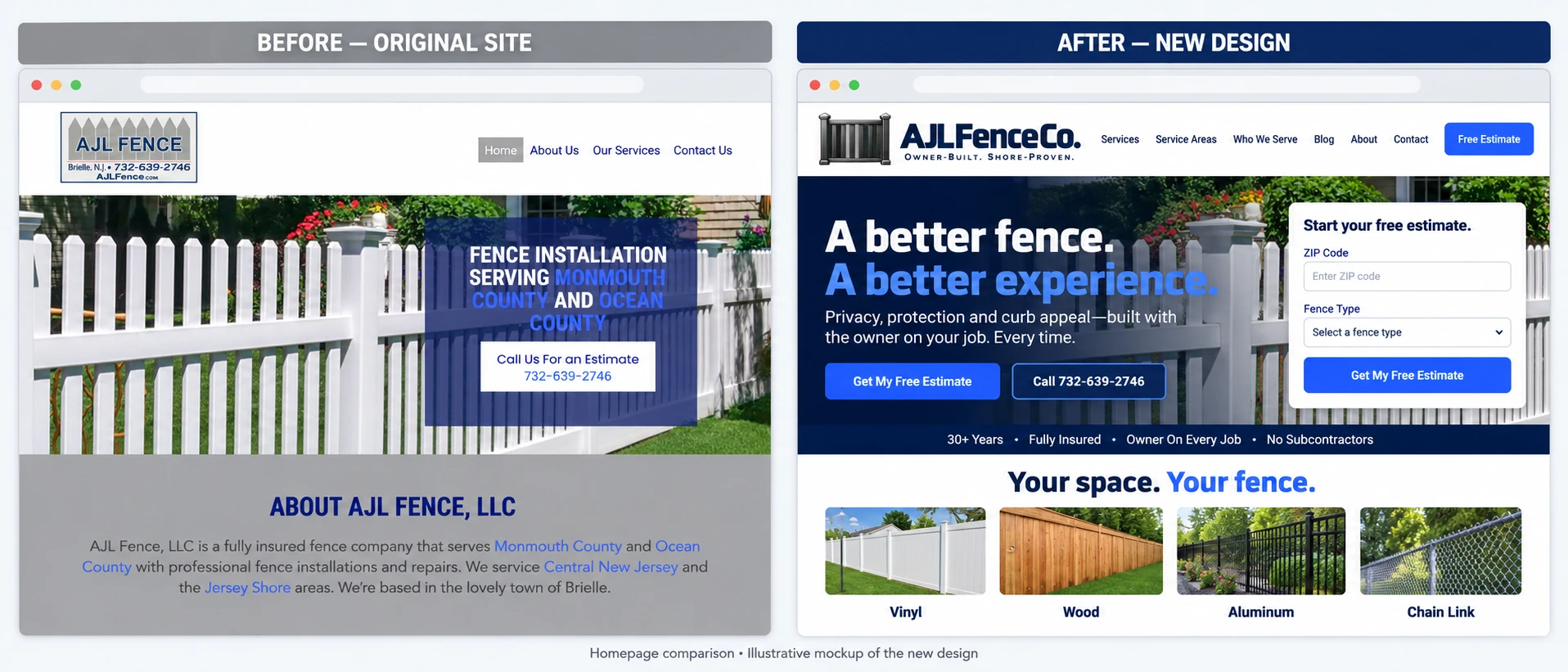
AJL Fence original homepage alongside an illustrative redesign with clearer services and an estimate form
AJL Fence: original site and illustrative redesign.

The details that matter

A closer look at your project.

What should an ecommerce website design project include?

A useful engagement begins with the catalog and the buying journey.

Explore this topic: What should an ecommerce website design project include?

A useful engagement begins with the catalog and the buying journey. We review product types, variants, collections, navigation, imagery, descriptions, shipping expectations, returns information, and the customer support path. The proposal defines the storefront pages, product-content responsibilities, platform configuration, integrations, migration requirements, and launch checks. Product uploads and ongoing merchandising should be scoped explicitly.

The storefront also needs a practical administrative setup. The business should understand who owns the domain and store, which subscriptions renew, which apps are required, and how staff manage products and orders. Theme customization, custom functionality, and third-party apps create different maintenance responsibilities. We identify those differences rather than treating every feature as part of a generic store package.

How do product pages help shoppers decide?

A product description should answer the buyer's actual questions.

Explore this topic: How do product pages help shoppers decide?

A product description should answer the buyer's actual questions. Depending on the item, that may mean materials, sizing, fit, care, compatibility, ingredients, dimensions, intended use, or what is included. Images should faithfully represent the item and its important details. A broad lifestyle claim cannot replace the practical information a customer needs before choosing a variant or placing an order.

We organize product copy so the strongest decision information is easy to find. Titles should identify the product clearly. Short summaries can explain its purpose, while detailed sections address buying objections and usage questions. Claims must be supported by the business. We do not invent certifications, reviews, health benefits, materials, or manufacturing details to make a page sound more persuasive.

How should collections, search, and mobile shopping work?

Collection architecture helps customers browse a catalog without already knowing an exact product name.

Explore this topic: How should collections, search, and mobile shopping work?

Collection architecture helps customers browse a catalog without already knowing an exact product name. We review how the audience thinks about the range and which distinctions are useful: category, use, size, style, occasion, or another real buying need. Filters should reflect available data rather than create an elaborate interface with inconsistent product attributes behind it.

On mobile, the path from collection to product, variant selection, cart, and checkout needs deliberate review. Important information should remain readable, controls should be usable, and product details should not disappear beneath oversized decorative sections. We also review cart behavior, relevant messages, and third-party widgets that can interfere with the shopping task or obscure the next step.

What do ecommerce SEO and Merchant Center involve?

Search foundations include understandable product and collection pages, descriptive metadata, internal links, appropriate canonicals, and a catalog structure that matches the store.

Explore this topic: What do ecommerce SEO and Merchant Center involve?

Search foundations include understandable product and collection pages, descriptive metadata, internal links, appropriate canonicals, and a catalog structure that matches the store. Product data needs to remain consistent across the visible page and connected feeds. A store with changing variants, prices, stock, or policies needs an update process that prevents stale information from spreading across channels.

Google Merchant Center work can involve reviewing product data requirements, supported platform connections, identifiers, availability, and policy information. Eligibility and approval remain platform decisions. Product structured data belongs on real product pages and must match the item being offered. The design engagement can include review or setup within a defined scope; it does not automatically include paid shopping campaigns or guaranteed listing approval.

For example, a real product page can describe a Product with its actual name, image, description, and SKU, then connect an Offer containing the live price, currency, availability, and purchase URL. Those values must agree with the storefront. This is an explanation of the structure; an agency service page should not pretend to sell a fictional product by publishing invented Product or Offer markup.

How should a store migration protect existing customers and search visibility?

A migration needs an inventory before data moves.

Explore this topic: How should a store migration protect existing customers and search visibility?

A migration needs an inventory before data moves. We review existing product and collection URLs, important content, redirects, customer information, order-history needs, integrations, and the practical limits of the source and destination platforms. What can be transferred depends on the systems and the permissions available. We confirm that scope before promising a complete move.

The launch plan should account for operational continuity. Product details, shipping settings, supported payment methods, notifications, policies, and order handling need review alongside design. Existing URLs should remain where practical or redirect appropriately. A final cutover should avoid leaving a public staging store or old domain presented as the primary destination in internal links and search metadata.

How do you verify the store and measure its performance?

Checks should follow the purchase journey: browse, open a product, choose an available variant, add to cart, review the cart, and complete an appropriate test checkout where supported and authorized.

Explore this topic: How do you verify the store and measure its performance?

Checks should follow the purchase journey: browse, open a product, choose an available variant, add to cart, review the cart, and complete an appropriate test checkout where supported and authorized. The team also needs to understand what happens after an order. Confirmation messages, fulfillment responsibilities, and support routes are part of the real customer experience.

Measurement should distinguish browsing, add-to-cart behavior, checkout activity, and confirmed purchases. Revenue and transaction data need careful validation to avoid duplicates or misleading totals. This service fits businesses with an actual product range and the operational ability to fulfill orders. Pricing depends on catalog size, copy, imagery, integrations, migration, customization, and support. Detailed case studies coming soon; no invented sales results are attached to the service.

Where can you review our work?

Detailed case studies coming soon.

Explore this topic: Where can you review our work?

Detailed case studies coming soon. You can explore the Automate2Generate portfolio for published examples of our work. We distinguish completed work from measured results and publish client-specific outcomes only when the evidence is available and approved.

How does our process work?

  1. Understand the catalog and operation

    We review products, variants, customer questions, imagery, fulfillment needs, existing systems, and administrative access. The discovery establishes the platform fit and the real scope of the store.

  2. Plan the storefront and content

    We map collections, navigation, page content, product information, policies, and purchase paths. Missing product facts and unsupported claims are resolved before design depends on them.

  3. Build and connect

    We implement the agreed storefront, content, supported integrations, search foundations, and measurement. Migration and feed responsibilities are handled within the defined scope.

  4. Verify and launch

    We review priority shopping journeys, operational settings, URLs, confirmations, and appropriate test transactions. The handoff explains how the business maintains the catalog and which continuing services are included.

The Automate2Generate difference

Why does editorial-grade writing make this work better?

Editorial-grade product writing explains the difference between items and gives shoppers a reason to choose confidently. We develop clear descriptions from verified product facts and the questions customers ask. That same discipline supports collection pages, size guidance, FAQs, and policy explanations. Search terms belong naturally within accurate information, while unsupported claims and repetitive supplier copy need scrutiny before publication.

Explore our SEO copywriting and content strategy for research, message development, and writing that gives the technical work something useful to support.

Which approach fits your business?

Compare scope, tools, and responsibilities
Planning comparison: actual scope depends on your business and chosen tools.
ConsiderationDo it yourselfTemplate / single toolAutomate2Generate
Content qualityYour team gathers product facts and writes the catalog.Starter sections still require accurate product information.Product and storefront copy is edited around genuine buying questions and approved facts.
Catalog structureYou organize collections and attributes.Navigation options depend on the theme and data.Collections and product information reflect how customers compare the actual range.
Search and feedsYou manage metadata, product data, and connections.Defaults and apps need validation.Agreed storefront, structured-data, and feed responsibilities are reviewed together.
OperationsYou configure orders, shipping, and support.A theme cannot define business operations.Launch and handoff account for the operational tasks included in scope.

What work can you see before deciding?

Explore our website portfolio to see published design and implementation examples. Detailed service-specific case studies are coming soon. Portfolio examples show the work; they are not a claim of measured traffic, rankings, or revenue gains.

How is pricing determined?

We scope the project around the pages, content, integrations, account access, and ongoing support you actually need. You receive a written proposal describing deliverables, exclusions, responsibilities, and any third-party costs before work begins. Ask us to separate one-time implementation from recurring support so you can compare the full commitment.

A few useful answers

Common questions.

Do you build Shopify websites?

Shopify storefront work can be included when it fits the product business and required features. We review the catalog, operation, integrations, and editing needs before confirming the platform and scope.

Can you redesign an existing Shopify store?

Yes. We assess the existing theme, content, apps, product structure, and customer journey. A focused improvement may be more practical than replacing every part of the store.

How much does an ecommerce website cost?

Scope depends on catalog size, product copy, imagery, customization, migration, integrations, and launch support. Platform plans, transaction costs, apps, and continuing services are identified separately.

Can you migrate my existing products?

We review the source and destination systems to determine which records can move and what needs cleanup. Product, customer, order, and URL migration responsibilities are confirmed explicitly before implementation.

Is product SEO included?

The build can include agreed product and collection content, metadata, internal links, and technical foundations. Ongoing ecommerce search strategy and content expansion need their own scope.

Can you connect Google Merchant Center?

Setup or review can be included where the platform and products support it. Data requirements and account eligibility must be checked, and final approval remains with Google.

Will you write my product descriptions?

Yes, when product copy is included in the proposal. Your team supplies or verifies the product facts, claims, specifications, and distinctions needed to write accurately.

Do you provide support after launch?

We define launch support and ongoing maintenance before the project begins. Catalog updates, merchandising, app changes, analytics review, and campaign work can be scoped according to the business needs.

How does this connect to your wider growth system?

Your next move

Let’s work on the right opportunity.

Tell us about your business and the result you want to improve. For an immediate conversation, call 732-569-1793. Project timing and response expectations are agreed during scoping.

We use these details to respond to your inquiry. This does not subscribe you to marketing texts or emails. Privacy policy.