

Built around your business
Clear message. Thoughtful design. Connected details.
A website should make choosing your business easier. A homeowner comparing contractors needs to understand what you build, where you work, and how an estimate starts.
What’s included in your project?
- Discovery review of your business, audiences, current pages, and inquiry journey.
- Service and navigation architecture with a defined page inventory.
- Original website copy shaped around real buying questions and approved evidence.
- Responsive layouts, accessible headings, clear labels, and keyboard-friendly navigation.
- Technical SEO foundations, page metadata, canonical URLs, and appropriate structured data.
- Working contact or booking paths with tested confirmation behavior.
- Launch review, access handoff, and clearly scoped support responsibilities.
Design in practice
See what a clearer experience looks like.
Explore our portfolio for website design and implementation examples.
Explore our work ↗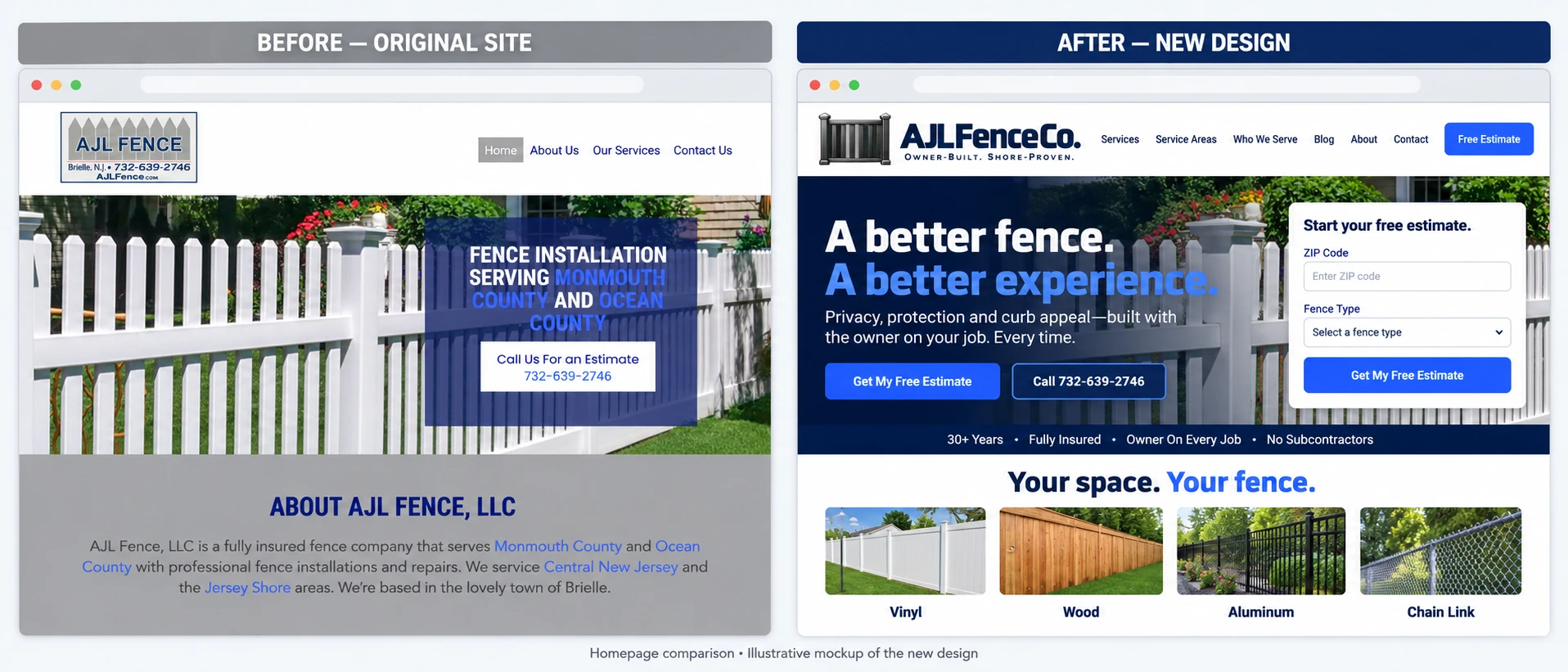
The details that matter
A closer look at your project.
What makes a website conversion focused?
A conversion is a meaningful business action, such as an accepted inquiry, a scheduled consultation, or a completed order.
What is included in a website design engagement?
The proposal defines the page inventory, content responsibilities, platform, integrations, and launch support.
Should you redesign or improve the website you already have?
A full rebuild is not always the first move.
How do mobile design and accessibility affect inquiries?
Mobile visitors need readable type, useful spacing, obvious buttons, and content that fits the viewport.
What should your content explain before someone contacts you?
Service copy should explain what you do, what is included, where the engagement starts, and what affects scope.
How do we measure and maintain the website after launch?
The launch review checks page responses, navigation, metadata, forms, redirects, key mobile layouts, and agreed analytics events.
Where can you review our work?
Detailed case studies coming soon.
How does our process work?
Discover the decision
We review the business, intended customers, strongest offers, existing website, and administrative access. Together we identify the action each important page should support and the evidence needed to make that action reasonable.
Plan the pages and message
We map services, navigation, internal links, and conversion paths. Copy is developed from business information and approved examples so layout decisions reflect real content rather than placeholders.
Build and connect
We implement responsive pages and the agreed forms, scheduling destinations, analytics events, and integrations. Search controls and staging behavior are checked before the site becomes the production destination.
Verify and hand over
We test agreed journeys, review mobile layouts and technical responses, and document ownership and maintenance responsibilities. Follow-on optimization is scoped around actual performance signals and business priorities.
The Automate2Generate difference
Why does editorial-grade writing make this work better?
Editorial-grade writing gives the design a useful job. We replace vague promises with clear service explanations, precise headings, and questions a customer would actually ask. That helps visitors scan, compare, and decide. Writing and technical SEO are reviewed together so a descriptive page title leads to content that fulfills its promise, and a persuasive CTA leads to a working action.
Explore our SEO copywriting and content strategy for research, message development, and writing that gives the technical work something useful to support.
Which approach fits your business?
What work can you see before deciding?
Explore our website portfolio to see published design and implementation examples. Detailed service-specific case studies are coming soon. Portfolio examples show the work; they are not a claim of measured traffic, rankings, or revenue gains.
How is pricing determined?
We scope the project around the pages, content, integrations, account access, and ongoing support you actually need. You receive a written proposal describing deliverables, exclusions, responsibilities, and any third-party costs before work begins. Ask us to separate one-time implementation from recurring support so you can compare the full commitment.
A few useful answers
Common questions.
How much does a small business website cost?
Scope depends on the page inventory, writing, platform, integrations, migration needs, and support. We review those requirements before quoting so you can see what is included and which ongoing costs are separate.
How long does a website take to build?
Timing depends on complexity, access, content approvals, and third-party integrations. The proposal sets a schedule after those dependencies are understood, with responsibilities for both your team and ours.
Can you improve my existing website?
Yes, when the current platform and structure support the required changes. We assess whether focused copy, performance, accessibility, or conversion improvements offer a better first step than rebuilding.
Is SEO included in website design?
The agreed build can include technical and on-page foundations such as crawlable content, titles, canonicals, and internal links. Ongoing search research, content development, authority work, and reporting require their own defined scope.
Will I own the website and domain?
Ownership and administrative access are documented before work begins. Platform licenses, subscriptions, paid assets, and third-party services can have their own terms, which should be understood alongside the project agreement.
Can I update the website myself?
That depends on the selected platform and the type of changes you want to make. We discuss editing needs during discovery and define the handoff or ongoing support approach before the build.
Will the website work on mobile?
Mobile layouts and priority user journeys are part of implementation and review. We check real content, forms, navigation, and contact details, while documenting any third-party limitations.
Do you guarantee more leads or first-page rankings?
No. We can improve the website and its inquiry journey, but demand, competition, traffic quality, pricing, and sales follow-up also affect outcomes. Reporting should show what changed without promising a result that a provider cannot control.
How does this connect to your wider growth system?
Your next move
Let’s work on the right opportunity.
Tell us about your business and the result you want to improve. For an immediate conversation, call 732-569-1793. Project timing and response expectations are agreed during scoping.